Arquà Petrarca
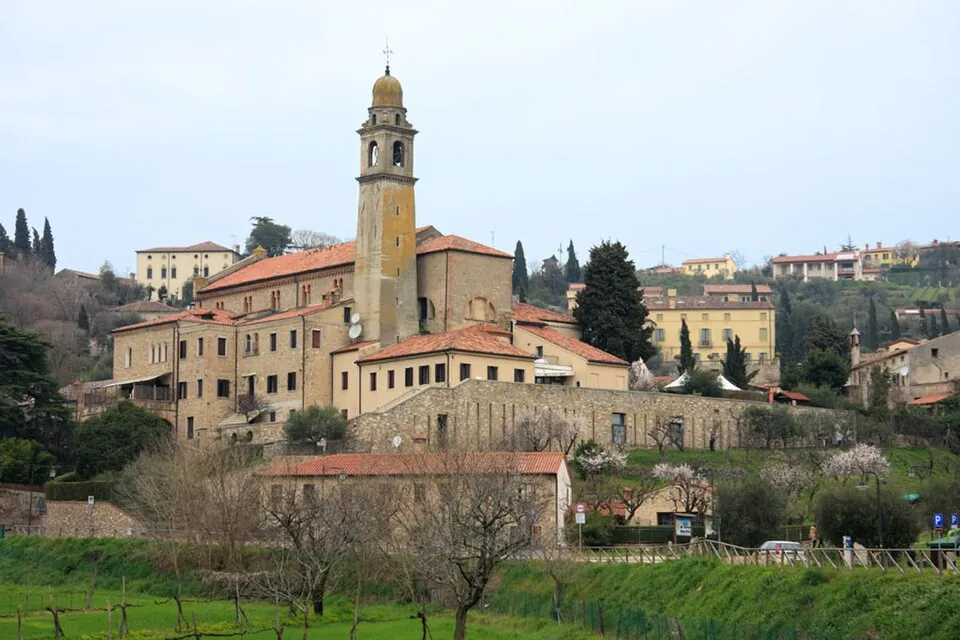
A medieval village in the Euganean Hills where Francesco Petrarca (Petrarch) spent his last years, with his house and his tomb in the square.
The story
The poet retired here and died in 1374. In his house, a mummified cat sits in a niche, with a Latin epigram presenting it as Petrarch's beloved cat: it was placed there in the 17th century by an owner of the house, and the legend has become part of the place. The village is also famous for jujubes, which gave Italian the saying «andare in brodo di giuggiole», to be over the moon.
Why go
An untouched village among the olive groves of the hills, perfect with a stroll and a glass of Fior d'Arancio.
In the itineraries
Get directions ↗OpenStreetMap ↗
Saved. You'll find everything in My trip, where you can split it into days and see it on the map.
Saved on this device: you can open it even without a connection. All your saved pages are in Offline guides.
Weather forecast
The forecast for the next 7 days at this spot: sky, temperatures, rain and wind.
Forecast by Open-Meteo (CC BY 4.0), from the models of national weather services. Your browser downloads it directly from Open-Meteo, and only when you ask. In the mountains and at sea the weather changes quickly: check the official forecast as well before you set off.
Getting there
- By train. The nearest station is Monselice station, 3.6 km away. Alternatively: Battaglia Terme station, 5.4 km away. From the station you need a bus, a taxi or a car.
- By air. The nearest airport is Venice Airport (VCE), about 55 km away.
- Parking. There are many signposted car parks within a kilometre; the nearest (Parcheggio Borgo Parte Alta) is 100 m away.
- ZTL. Many Italian historic centres are limited traffic zones (ZTL) monitored by cameras: if you arrive by car, leave it outside the centre and check opening times and permits on the town council's website (your hotel may be able to register your plate).
Stations, ports, airports and car parks from OpenStreetMap (© OpenStreetMap contributors, ODbL); distances as the crow flies. Timetables and connections change: check them before you travel.
Climate month by month
The most pleasant months for weather are from April to June and from September to October, with average highs between 18 and 29 °C. From July to August it is hot: average highs exceed 30 °C. The wettest month is May (about 106 mm), the driest January.
| Month | Temperature | High / low | Rain mm |
|---|---|---|---|
| Jan | from 1 to 8 °C | 8° 1° | 35 |
| Feb | from 3 to 11 °C | 11° 3° | 61 |
| Mar | from 5 to 14 °C | 14° 5° | 50 |
| Apr | from 8 to 18 °C | 18° 8° | 62 |
| May | from 13 to 22 °C | 22° 13° | 106 |
| Jun | from 18 to 28 °C | 28° 18° | 66 |
| Jul | from 21 to 32 °C | 32° 21° | 68 |
| Aug | from 21 to 32 °C | 32° 21° | 74 |
| Sep | from 16 to 26 °C | 26° 16° | 76 |
| Oct | from 12 to 21 °C | 21° 12° | 88 |
| Nov | from 6 to 14 °C | 14° 6° | 78 |
| Dec | from 2 to 9 °C | 9° 2° | 50 |
Averages for 2015–2024, estimated for an altitude of 78 m. Air: NASA POWER (MERRA-2 reanalysis), corrected for the altitude of the place; rain: average monthly total. These are indicative values: the weather on any given day can be very different, so always check the forecast before you go.